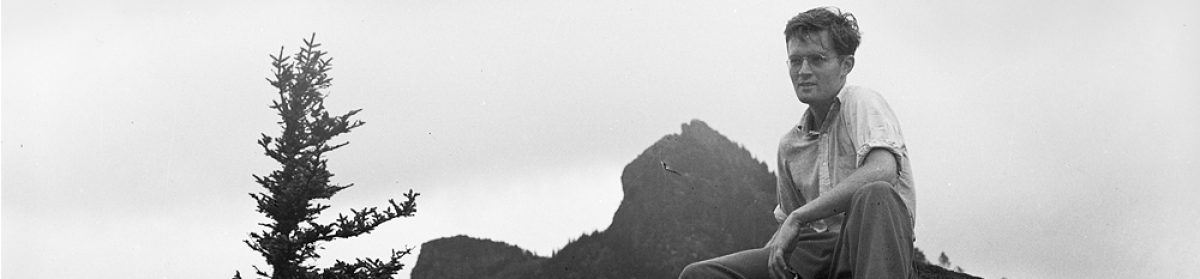
This is a question I was asking myself from the time I started working on the Morton collection until recently, when I happily discovered the answer. A particular batch of Morton negatives labeled “Singleton C. Anderson, Rocky Pt.” caught my attention when I was making my first survey of Morton’s photographs. I noticed them because 1) they were striking black-and-white images from the circa 1950 period, and 2) they depicted African Americans in a non-athletic setting (somewhat unusual in Morton’s work).
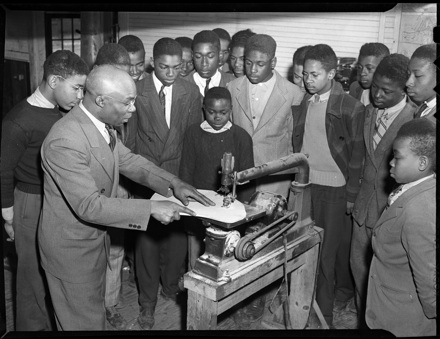
Some quick Google searches at the time were fruitless; I suspected the images showed scenes from a Rosenwald School, but I didn’t have time to look into it any further. But the images, and Anderson, stuck with me. I just had a feeling they were important. So when I came upon them again recently during processing, I figured “what the heck,” and tried another Google search. Jackpot!
The site I found, Under the Kudzu, is run by educator and writer Claudia Stack, who is now in the process of creating a feature-length documentary film focused on the Rosenwald school movement as shown through two schools in Pender County, NC: the Canetuck Rosenwald School, a primary school, and the Pender County Training School, a high school. PCTS was located in, yes, Rocky Point. I emailed Claudia immediately and attached jpegs of the images included in this blog post. The next day, I got this reply:
I am ASTOUNDED at these images . . . I have been researching PCTS and Singleton C. Anderson’s profound impact on the region for the past six years, but images are very hard to come by. That is partly, I think, because he was a humble man, and partly because a tragic house fire claimed the life of his wife, Vanetta Anderson, and also all of their papers and pictures.
So, who in fact WAS Singleton C. Anderson?
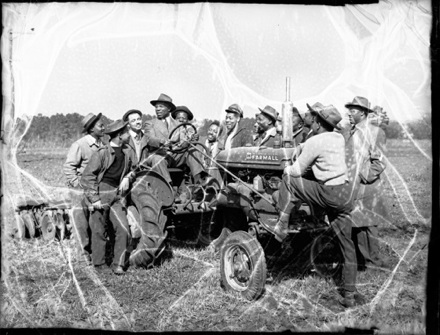
Here’s the short answer, culled from Claudia’s notes: Singleton C. Anderson was born Feb. 22, 1896 in Columbia, VA, educated at the Hampton Institute and came to the Pender County Training School (which had been founded in 1917) in the early 1920s to teach agriculture, wood working, metal working, masonry, and animal husbandry. Local families were distrustful at first, thinking they didn’t need any help teaching farming to their children. But Anderson won them over with his energy and abilities: “The story goes that when people saw how hard he worked and how skilled he was, they began to see the value of what he had to teach,” writes Claudia.
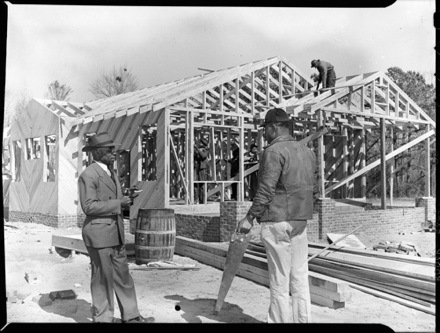
Anderson also contributed hugely to the surrounding community by leading home-building and landscaping programs — he is credited with 160 “home-raisings,” meaning the landowner would buy the materials, and Anderson and his students would build the house at no additional cost.
The impact of Anderson, the PCTS, and the Rosenwald School movement will be fully explored in Claudia’s film and through an exciting event to be held at UNC-Wilmington on November 13, the Rosenwald School History Awareness Conference, where scholars, preservationists, alumni, and community members will gather to discuss African American education during segregation. (See Claudia’s thoughtful October 2008 piece from the Star News for more on this topic).
One question remains: why did Hugh Morton take these rare photos of Anderson? Was he on assignment from a newspaper or other publication? It seems doubtful he would have been pursuing his own interests. Was there, as Stephen suggested to me, a connection between Anderson and Morton’s grandfather Hugh MacRae, who was also involved in agriculture in Pender County? Did Anderson himself initiate the photos, for some purpose of his own? Claudia reported that she showed these images to a former student of Anderson’s, who commented, “those are church hats” — meaning, Claudia thinks, that the photo ops seem to have been staged.
It just goes to show how one man with a camera, in the right place at the right time (as Hugh Morton so often was), can create documents of great, and sometimes unexpected, significance.
as a young pilot in the late sixties,I flew a plane for hugh to take photos.are there photos that he took from the air around?
I’ve never known S.C.Anderson to not have a hat on outside. He always wore hats outside just like the ones on the pictures. He was my father.
Bert, we have tons of aerial photos Morton took. See the finding aid for an inventory, though most are unidentified. Where were you flying?
I knew him as professor Anderson,During my time in his class,I learn a lot. Today I am a home owner and the things that he taught me are coming in handy for me as a home owner. His teaching has saved me a lot of money in repairs. I like to thank Mr Anderson for all of his help.
I was a student of Professor Anderson’s from 1961-1965. He taught me how to do woodworking, judge livestock (cows and pigs) and placed me in an Oratorical Contest for the district. I won 2nd place. He visited my home on more than one occasion and was someone I highly respected. He also arranged for me to attend a summer camp for a week at Swansboro, NC, at the New Farmers of America/4 H Camp. It was there that I learned to swim. He greatly influenced my life.
Morton’s photos of Anderson are currently on exhibit at the Pender County Public Library. An event is scheduled for 3/6 entitled “Professor Singleton C. Anderson: Impact of a Life.”
I moved north from NC several years back, but I can personally attest to the deep impact which Singleton Anderson had on Pender County and the surrounding areas. Family members and friends of mine from NC always spoke so highly of what he had to offer. Very glad to see these pictures. Cheers.
Great news! The Canetuck Community Center (formerly the Canetuck Rosenwald School) in Pender County has been awarded a $40K grant from the Lowe’s Charitable and Educational Foundation to revitalize the historic building and make it energy efficient. More details here.
i went to school in nc later from 1969-1981 but it is interesting to see history of how African Americans with the help of others persevered and became outstanding citizens in America. Thank GOD