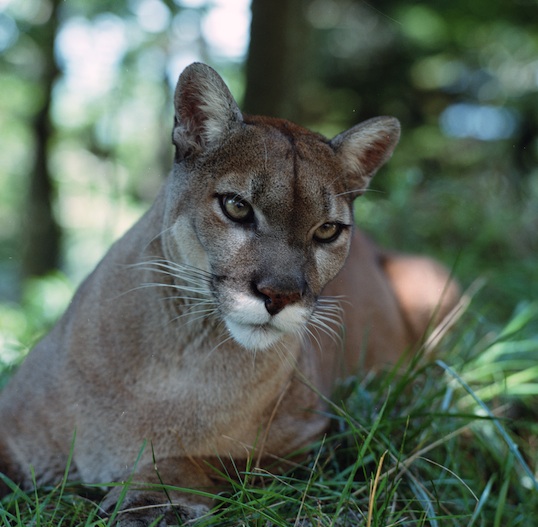
The U.S. Fish and Wildlife Service has confirmed that the Eastern Cougar (a.k.a. puma, mountain lion, catamount, red tiger, or “ghost cat”) is officially extinct — i.e., there have been no wild breeding populations of the species since, probably, the 1930s. Officials blame continuing, numerous mountain lion sightings in the eastern states on mistaken identity (either another animal entirely or a migrating Western Cougar), or on big cats escaped from captivity — though they may have trouble convincing many locals of that!
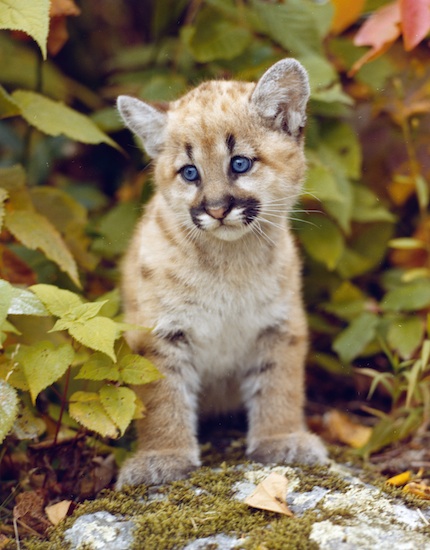
This sad news does provide an opportunity to highlight some of Hugh Morton’s striking photos of cougars in the wildlife habitats at Grandfather Mountain.
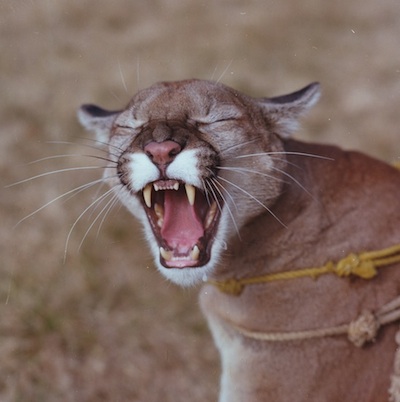
I’m not entirely sure when the first cougars came to Grandfather (circa late 1970s-early 1980s), or of the impetus for creating a habitat for them — perhaps some of the staff at Grandfather can shed light on that story? But I believe the image below to be one of those inaugural cougars, named Terra and Rajah, possibly upon arrival at the Mountain (judging from the ropes and the unhappy attitude). (Of these two, only Terra, shown in the photo at the top of this post, was an Eastern Cougar — Rajah was Western).
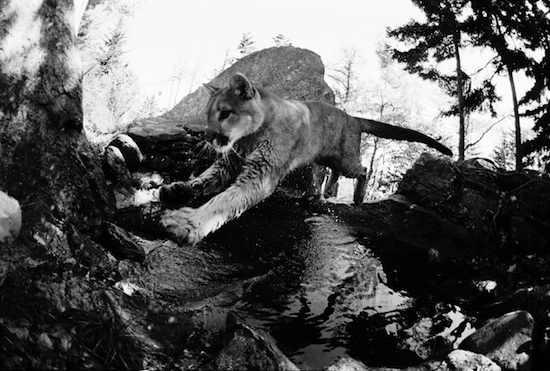
Mr. Morton was obviously taken with the animal’s extreme elegance and athleticism. He tried repeatedly to capture that perfect “cougar leap” image. I’m particularly fond of the shot below (taken in 1982 of the cougar named Judy).
Two cougars, Nakita and Aspen, currently live at Grandfather (though the website doesn’t say whether either or both of them are Eastern Cougars). At least, through captivity programs like Grandfather’s, we can take comfort that not all of these incredible animals will become “ghosts.”
Elizabeth Hull
NC is clog wild
I just happened to catch a news item that current Miss North Carolina Adrienne Core won the talent portion of the 2011 Miss America Pageant with “a fast-paced, contemporary clogging routine.” Many may already know that clogging is NC’s official state folk dance. I remember doing a bit of clogging (terribly) in my youth in Boone, and seeing some pretty amazing performances by clogging troupes, but I know nothing of the dance’s origins. According to Wikipedia,
Clogging is a type of folk dance with roots in traditional European dancing, early African-American dance, and traditional Cherokee dance in which the dancer’s footwear is used musically by striking the heel, the toe, or both in unison against a floor or each other to create audible percussive rhythms. Clogging was social dance in the Appalachian Mountains as early as the 18th century.
Fascinating to consider how those European, Cherokee and African American influences might have come together! From Wikipedia I also learn the interesting tidbit that “in the U.S. team clogging originated from square dance teams in Asheville, North Carolina’s Mountain Dance and Folk Festival (1928), organized by Bascom Lamar Lunsford in the Appalachian region.” (Mr. Lunsford has been discussed on this blog a few times in the past, including in detail in one of our “Worth 1,000 Words” essays).
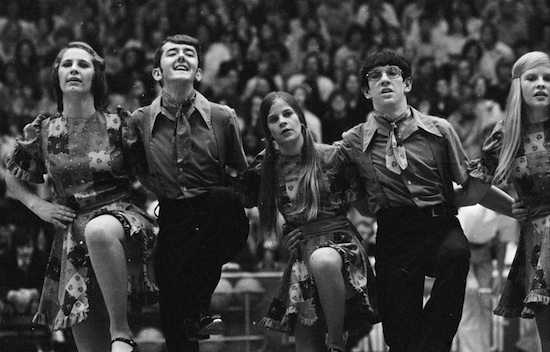
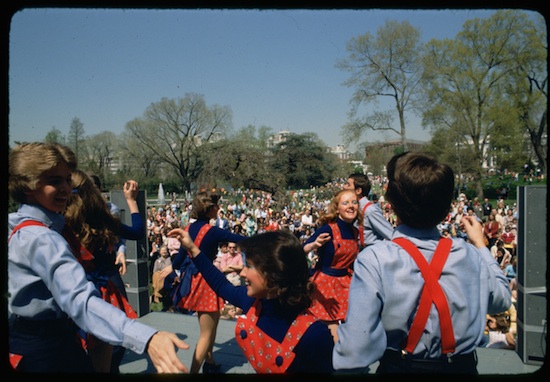
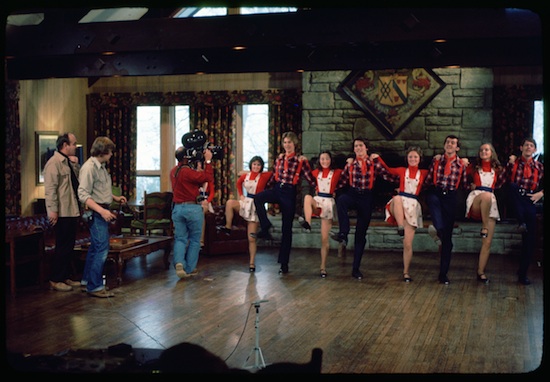
Hugh Morton took many photos of the world-renowned Grandfather Mountain Cloggers troupe, including the one above, which shows the Cloggers performing during halftime of a 1974 UNC-Maryland basketball game, and those below taken at the 1977 White House Easter Egg Roll and during the taping of a segment of Charles Kuralt’s “On the Road.”
I’m curious to learn more about the origins of the Grandfather Mountain Cloggers. Who founded the troupe? What became of it? Internet searches turn up little except for a very small Facebook group, whose description intriguingly invites “all those who were members back when clogging was a precision dance.” Is it no longer considered as such? Are there raging stylistic debates in the world of clogging? I’m dying to know.
Autumn Gallery
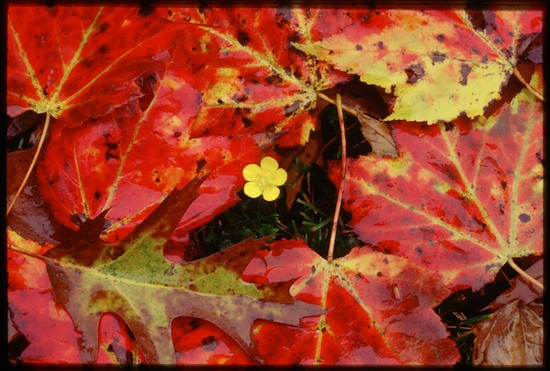
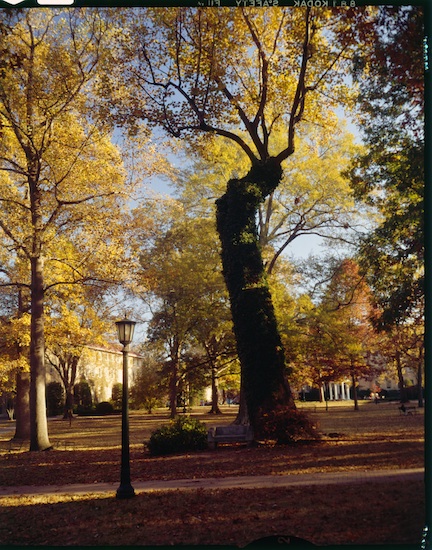
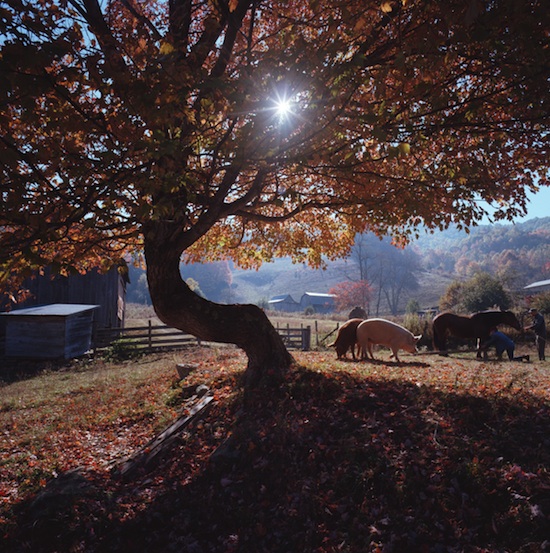
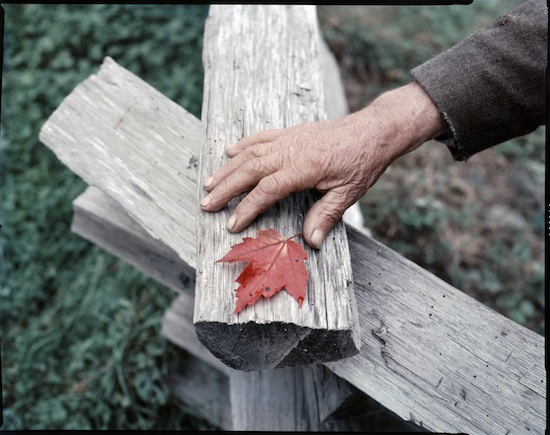
I’m headed up the mountain to Boone this weekend, hoping to catch what’s left of the colorful fall leaves. Here in Chapel Hill, they’re just getting started.
Hugh Morton, of course, had a marvelous eye for capturing fall displays; here for your enjoyment are a few showstoppers as well as some of my personal favorites.

Worth 1,000 Words essays on LEARN NC
 We’re very pleased to announce that nine of our Worth 1,000 Words essays are now included as part of the online educational offerings of LEARN NC, a well-respected teaching and learning resource program from the UNC School of Education. The essays are part of North Carolina History: A Digital Textbook. Here’s the description from their website:
LEARN NC’s “digital textbook” for 8th-grade North Carolina history offers a new model for teaching and learning. This “digital textbook,” designed for grade 8 and up, covers all of North Carolina history, from the arrival of the first people some 12,000 years ago to the present. Far more than a textbook, though, it’s a collection of primary sources, readings, and multimedia that you can search, select, and rearrange to meet the needs of your classroom. To build critical thinking and literacy skills, special web-based tools aid reading and model historical inquiry.
We’re thrilled to be able to get our essay authors’ work more easily into the hands of teachers and students, and want to say thanks to LEARN NC for this great collaborative opportunity!
Mystery photo: Two men and a monkey
A few weeks ago I launched into a fiftieth anniversary post on Hugh Morton’s photographs made during John F. Kennedy’s campaign tour in North Carolina. In the course of researching the post, I got intrigued by the story behind the event and began reading Triumph of Good Will: How Terry Sanford Beat a Champion of Segregation and Reshaped the South by John Drescher. In the mean time as that post takes shape, I’m posting the following lighter fare from Elizabeth. —Stephen
***********************************************************************************************************************
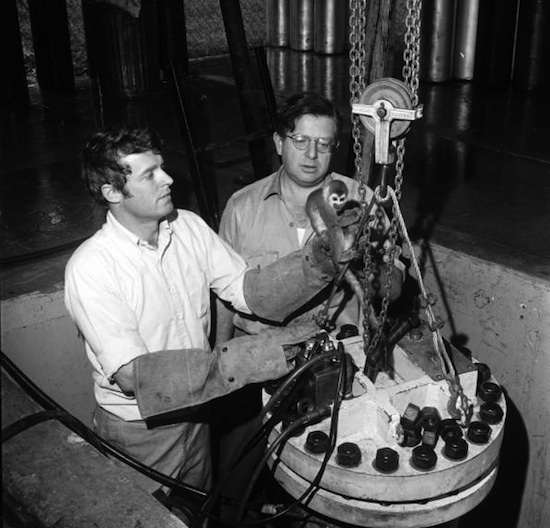
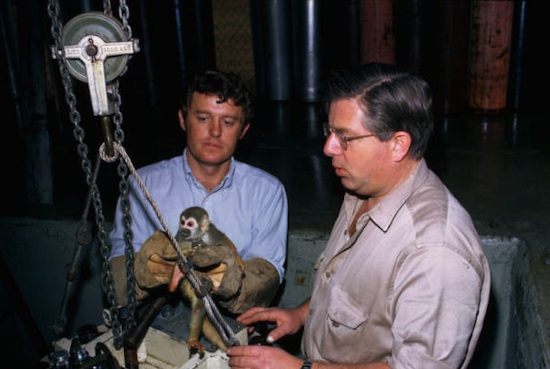
Can anyone help us out on this one? We’re stumped by these images of two men, a small monkey, and some kind of industrial equipment. What the heck is going on? (Morton included the color version in a slide show he titled “Superlatives,” but we’re unsure as to the “superlative” nature of the image content. Monkeys are superlative, in my opinion, but is there more to it than that?). Let us hear from you in the comments!
A processor's (concluding) perspective

Looking back at the first blog post I wrote nearly three years ago, I have admittedly mixed feelings about how the Hugh Morton processing project has proceeded, and is now wrapping up. Don’t get me wrong — when I compare these “after” pictures of the collection with the “before” shots in that first post, I feel an undeniable satisfaction, that particular archivists’ sense of triumph at having wrestled what was essentially a BIG OLD MESS into something that is organized, nicely rehoused and labeled, physically stabilized, digitized (in part), described, and accessible to the public.

Still, there is a niggling part of me that suspects, deep down, that my victory over the Morton beast is incomplete . . . that despite three years of hard work (not just mine, but also that of numerous and wonderful students and volunteers), the collection still somehow got the best of me. [Note from Stephen: the collection also got the best in Elizabeth.] In the past, I’ve left behind most of my projects/collections with a sense of closure — I had thoroughly beaten those collections into submission, and it was unlikely any processor would ever have to work on them again (or at least for a very long time). Not the case with this one! A person could devote a CAREER to the Morton Collection and still not be “finished.”
In that first post, I wrote:
Since I began working on the collection . . . I have had regular moments of crisis during which I become nearly paralyzed by all the challenges associated with and possible approaches to this project. How do you impose order on chaos, while respecting what few pockets of order do exist? How do you decide what to digitize, and when? How do you balance the needs and interests of the many people who will use this collection with the preservation needs of the material itself?
I’m not sure that we ever found firm answers to these questions, or that we ever really will. But the answer we have to go with is, “we do our best.” And that’s what we did!
- We digitized, described, and made available online more than 7,500 images in the Hugh Morton Digital Collection
- We organized the collection into nine series by subject, and described everything in detail in the collection’s finding aid, and linked it up to the digital collection at the subseries level
- We tracked our progress and highlighted special topics/images in this blog, and built upon it through the Worth 1,000 Words essay project
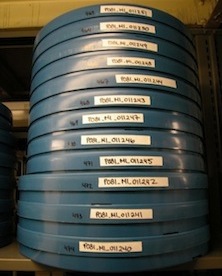
And what of the future, you ask? First and foremost, A View to Hugh will continue! North Carolina Collection Photographic Archivist Stephen Fletcher will be taking over primary author and editorial duties, but I will likely contribute now and again. We may not post as often as we have for the past three years, but there’s just too much fascinating, beautiful, relevant stuff in this collection — we simply must share!
I’ll be moving on to other collections here in the North Carolina Collection Photographic Archives, but will still be around and completing a few remaining Morton-related clean-up tasks. Morton Collection-related inquiries should be directed to Stephen; information about reproductions is available on the NCCPA Requesting Reproductions page.
Until next time,
–Elizabeth Hull
Tar Heels and Touchdowns and Tigers, Oh My!
Note from Elizabeth: This latest post from JACK HILLIARD is certainly timely, though not in a good way, given the negative national attention currently being drawn to UNC’s football team. Here’s hoping the Heels can rise above the mess this Saturday in their latest match-up with LSU.
It’s being billed as the “Daytona 500 of College Football.” The Chick-Fil-A Kickoff Game will match two projected preseason top-25-ranked teams: UNC’s Tar Heels and LSU’s Tigers. The game, scheduled for 8 PM on Saturday, September 4th in Atlanta’s Georgia Dome, will be a nationally televised event on ABC Sports and will be the first game in Carolina’s 122nd season of college football.
UNC will be meeting LSU for the seventh time, but the Tar Heels have won only once during the series which dates back to 1948 . . . and that ’48 game is the one win. Following that win, UNC Head Coach Carl Snavely said, “Best game since Texas!” (referring to Carolina’s win over Texas to start the 1948 season).
LSU’s Tigers came into Kenan Stadium on October 23, 1948 to meet a Tar Heel team that had won 11 straight games and was ranked 3rd in the country. From the opening whistle, it was apparent that Coach Snavely had the Tar Heels ready to add a 12th game to the string. Charlie Justice and company were brilliant, much to the delight of the 41,000 fans on hand. Among them, in his special place along the Carolina sideline was photographer Hugh Morton. Once again, Morton captured on film that afternoon a classic photograph of Justice — an image that would be reproduced often in books and magazines when the Justice story is told.
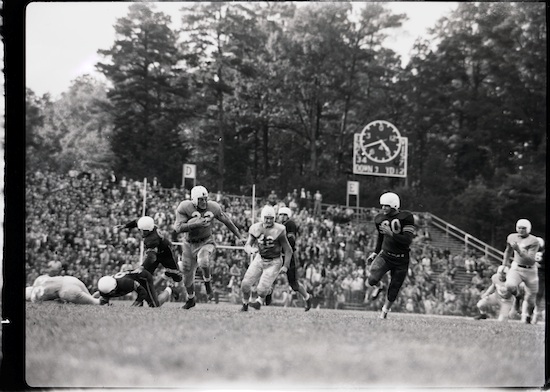
When the dust settled on the Kenan turf, the final score was Tar Heels 34, Tigers 7. Carolina would go on to win four more games in 1948 and finish the season undefeated. A trip to the ’49 Sugar Bowl was their reward.
One year later, almost to the day, on October 22, 1949, Snavely’s Tar Heels were in Baton Rouge for a return engagement with the Tigers. The Tar Heels were still riding a 20-game regular season win streak. It was a night game, one of three during the Justice Era. On Friday afternoon Snavely put his troops through a vigorous workout that went into night. The lateness of the hour may have triggered a chain of events that played a part in the Tar Heel loss.
According to LSU Head Coach Gaynell Tinsley, it was the custom for the LSU grounds crew to water down the field following the visiting team’s practice, but since the Carolina practice lasted so long, Coach Tinsley told the crew to go on home and do the watering early Saturday morning. But after Carolina finished its workout, the LSU team managers took it upon themselves to go ahead and water the field. When the grounds crew came in on Saturday morning, they did as they had been told and watered the field also. By the time the Tar Heels arrived for the game, Tiger Stadium was under two inches of mud and water (according to Charlie Justice in a 1989 interview).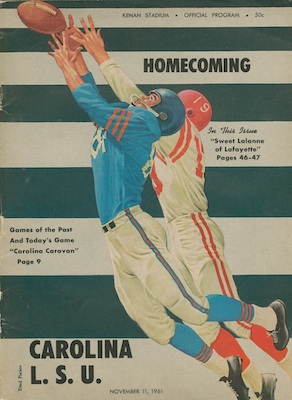
Ironically, the weather forecast for the Thursday before the game had been for rain, and Coach Tinsley, in his weekly news conference, indicated the Tigers would have a better chance on a muddy field, saying his players were better “mudders” than most teams. Well, it didn’t rain on Thursday, or Friday, or Saturday. Justice said it was “sunshine hot.” Sports writer Bud Montet wrote in Saturday’s “Baton Rouge Morning Advocate” that the Tiger turf was in perfect shape, adding, “if no further rain . . . Choo Choo Justice will have as fine a field to run on as he’s ever seen in his college career.”
Needless to say, Justice, Weiner & Company had problems keeping their footing on the slick field, much to the delight of many of the 43,000 in attendance. LSU, as predicted, played much better on the wet turf and snapped the Tar Heel winning streak by a 13 to 7 score.
“How wet was the field?” One Sunday morning daily jokingly put it this way: “There was a three-inch drop in the Mississippi River over the weekend.” And when the 1950 Yackety Yack came out, the lead sentence for the game read: “On a muddy field in a city where it hadn’t rained in a week, the Tar Heels dropped their first game in 21 appearances.” John Lardner, writing in Newsweek magazine, titled his column “The Water-Sprinkler Blues.”
The Tigers continued their winning ways when they came to Chapel Hill in 1961 for Homecoming, and haven’t looked back since, winning in ’64, ’85 and ’86.
The 7th game in the series could be the charm for the Heels. At least the field will be dry inside the Georgia Dome!
–Jack Hilliard
Loafer’s Glory, or happiness in the hills
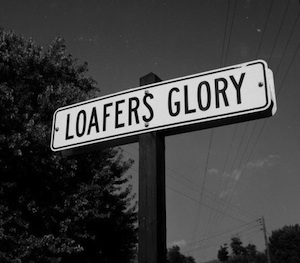 I want to go back to Loafer’s Glory and have another cup of coffee in the small diner there, look out the windows at the wooded hills, maybe while away some time “just sittin,” as the mountain folk say. Watch the play of light and shadow on the mountains and perhaps discreetly observe the people as they come and go.
—Thomas James Martin, 2001
In my last post, I mentioned a messy box of roll film I found, previously overlooked, in the stacks. As dirty and jumbled as the box was, I assumed it would be filled with, shall we say, less-than-premium examples of Hugh Morton’s work. I was (at least partially) wrong. Among the many rolls of the Morton sons’ high school basketball games I found shots of Terry Sanford’s 1961 inauguration as NC Governor, Kerr Scott at the 1956 Democratic National Convention, and Billy Graham preaching at “Singing on the Mountain” in 1962, among other high-quality scenes.
I also found an intriguing roll of 120 film depicting a North Carolina destination with which I was unfamiliar — a very small community in the NC mountains called “Loafer’s Glory.” To quote Mr. Martin again, “Loafer’s Glory is a wide place in the road in the mountains of western North Carolina. At last count less than a hundred souls live in the community, but at least there is a caution light marking the spot on NC Highway 226 where it it intersects NC 80 of this ‘gloriously’ named town near the Tennessee border perhaps 50 or 60 miles west of Asheville.” (Be sure to read the entirety of Martin’s lovely article on the importance of taking time to “loaf”).
According to a resource on Mitchell County Place Names, Loafer’s Glory “is probably Mitchell County’s most famous named place. Located at the bend of the river about three miles north of Bakersville, Loafer’s Glory was reputedly coined by the women of the community, who took a dim view of the men’s habit of ‘lollygagging’ on the porch of the community soter, rather than working.”
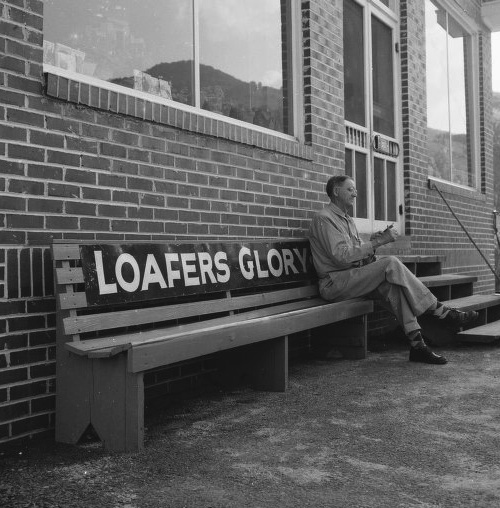
Hugh Morton appears to have visited the community sometime in the 1950s-early 1960s, on his way to or back from a “hillbilly festival” taking place in the middle of the road (the two shots below are on the same roll of film as the Loafer’s Glory images). The road signs for highways 64 and 28 in the bottom image would indicate a location of Highlands, NC, which then leads me to the distinct possibility that these are shots of “Highlands Hillbilly Days.”
According to Anthony Harkins’ Hillbilly: A Cultural History of an American Icon, the Hillbilly Days were held each August between 1951 and at least 1957 — “participants dressed as hillbillies and participated in beauty contests, as well as the more traditional pursuits of wood chopping, square dancing, and ballad-singing” (263).
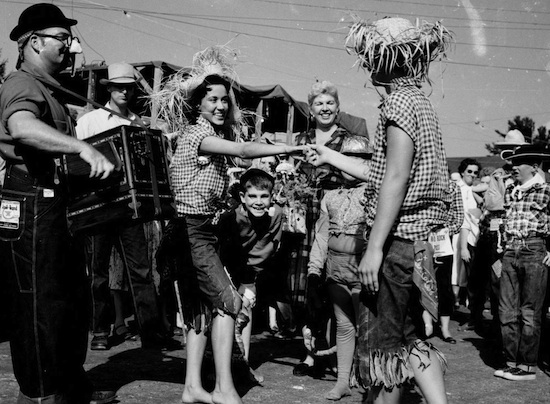
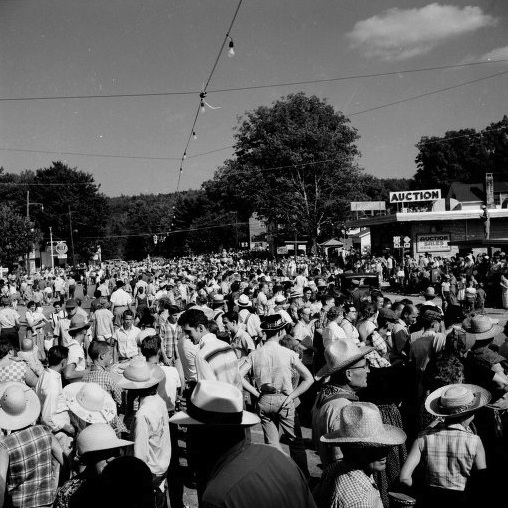
Can anyone verify this? Is this, in fact, “Highlands Hillbilly Days”? And, have you ever loafed in Loafer’s Glory?
The Grey Fox and Sunny Jim, part 2
Note from Elizabeth: this post from JACK HILLIARD continues a two-part tribute to two Hall-of-Fame UNC football coaches: Carl Snavely, a.k.a. the “Grey Fox” (head coach from 1934-1935 and 1945-1952; see part 1) and Jim Tatum, or “Sunny Jim” (head coach in 1942 and from 1956-1958), who passed away on July 23, 1959 at the age of 46.
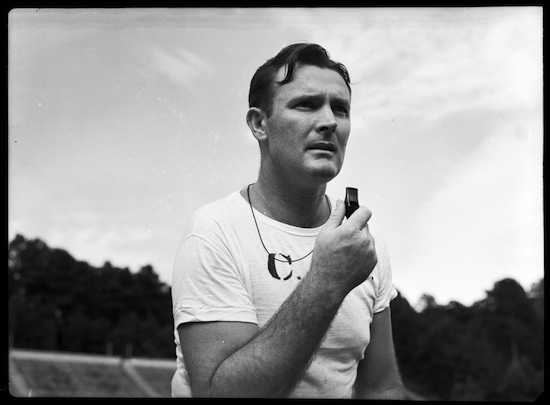
Three seasons after Carl Snavely left UNC, a charismatic character arrived from the University of Maryland. During the 1955 season, when Maryland was undergoing some administrative changes, head coach Jim Tatum would often spend Sunday nights having dinner with Charlie Justice. (Justice was in the area because he was doing color commentary on the Amoco Redskins TV Network each Sunday afternoon). Charlie believed that Tatum was the answer to UNC’s coaching problems and tried to talk him into returning to Carolina. Tatum had been a UNC assistant coach from 1938 to 1941 and head coach in ’42, plus he played for Coach Snavely in 1934 and ’35. Whatever the reason — Tatum’s unhappiness as both head coach and athletic director at Maryland, or Justice’s convincing ways — he returned to Carolina in 1956. Said Tatum, “I’m like an old br’er rabbit going back to the brier patch.”
The front-page headline in the January 9, 1956 Washington Post read: “Tatum Goes To North Carolina.”
Since “Sunny Jim,” as many called him (others called him “Big Jim,” and his players called him “Bullmoose”) had been so successful at Maryland with three 10-game-winning seasons, five bowl teams and a national championship in 1953, Tar Heel alumni and fans thought they were headed once again for greatness. You could go downtown in Chapel Hill and get a slice of “sweet Tatum pie” at the Carolina Coffee Shop, or you could get a trademark Tatum ten-gallon hat from Monk Jennings and Bob Cox at Town & Campus clothing store.
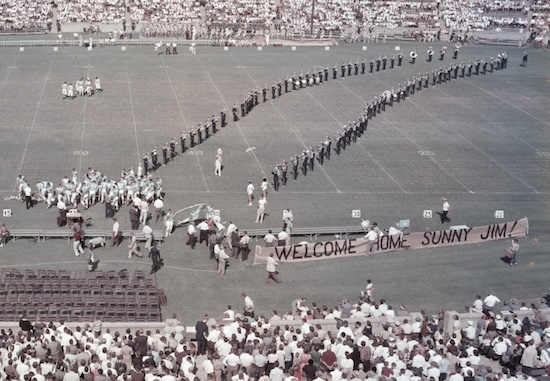
Below is a detail from a Hugh Morton image of Tatum’s triumphant return to Kenan Stadium on September 22, 1956, for a game vs. NC State (click to see full version). But the ’56 Tar Heels struggled, winning only 2 games. It would be Tatum’s only losing season.
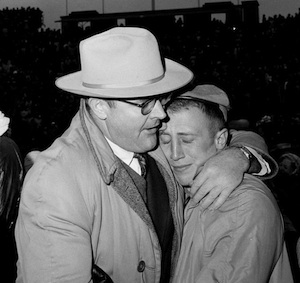
In ’57, thanks to “Sunny Jim’s” enthusiasm and optimism, things took a turn for the better. An early season win over nationally ranked Navy and a win over Wake Forest, despite having to suspend three players prior to the game with the Deacons (including quarterback Dave Reed), and finally a win over Duke, had Tar Heel fans looking up. A classic Hugh Morton image of Coach Tatum and an emotional Dave Reed following the game at Duke (see below) has been widely published and was a Morton favorite.
 The 1958 season started off slow, but a win at Southern Cal on October 3rd had fans cheering again. Everything pointed to the 1959 season . . . that would be the year that Tar Heel football would be great again. Said Tatum, “1959 will be our year. That’s what I’ve been building for all this time.”
On Thursday, July 16, 1959, Jim Tatum played a round of golf at Hope Valley with his friends Carrington Smith, Vic Huggins, and Orville Campbell. Upon finishing the round, Tatum asked Campbell to drive him home saying, “I don’t feel good.” On Sunday, the 19th, he was hospitalized.
By now the media had picked up on Tatum’s illness. On Thursday evening July 23rd, across the state in Greensboro, WFMY-TV Sports Director Charlie Harville was just about to go on the air with his 11:20 PM sports report when he was paged for a phone call. It was Chuck Erickson, UNC Athletic Director, who passed on the news that Jim Tatum had died at 10:40 PM. Harville struggled to report his friend’s death. Jim Tatum was 46 years and one day old. The opening game of the ’59 season was 57 days away.
I remember being in summer school on Friday, July 24th. As I walked from Manly dorm to my class in Phillips Hall, the campus was silent. I don’t ever remember being on campus when there was absolutely no sound — but on this day there was nothing but silence.
September 19, 1959 was a picture-perfect autumn day in Chapel Hill. (Perhaps I should say a Hugh Morton picture-perfect autumn day). Clemson came to town and handed the Tar Heels the first of 5 defeats during the 1959 season . . . a season that had so much promise just wasn’t to be.
Jim Tatum was inducted into the National Football Foundation’s College Football Hall of Fame with the class of 1984. Tatum’s Hall of Fame plaque was presented to his widow Edna by his friend Charlie Justice.
When UNC alumni and fans get together, often the subject of football will come up in conversation and invariably someone will ask, “What if ‘Sunny Jim’ had lived? Could he have taken the ’59 Tar Heels to the place where the ‘Grey Fox’ had taken them in ’48?”
We’ll never know.
–Jack Hilliard
All nine series now available!
 It’s been a while since I announced an update to the finding aid for the Hugh Morton collection . . . but that’s because I’ve been saving up until I could reveal ALL of the remaining series at once. (Not intentionally, actually — it just kind of worked out that way). So yes, this means that almost all* of the Morton collection is now open and available for research!
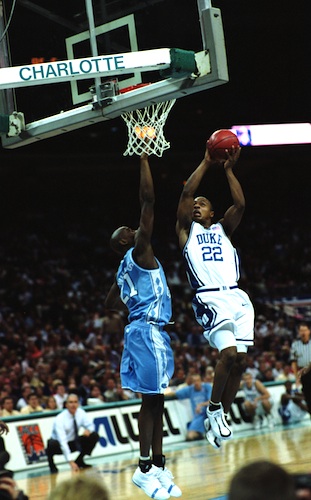
Of greatest interest to many will be the Sports Series (series 6), which contains the absolute gold mine that is Hugh Morton’s UNC basketball photography. Morton took an amazing 30,000 photographs of UNC basketball, dating from the beginning of his time as a UNC undergrad in 1939 through the early 2000s (see left). We worked hard and very carefully to process this portion of the collection, knowing how popular these would be. Along the way, we digitized about 1300 of them, which (in case you need a reminder) are available online in the Hugh Morton digital collection. (Big props to our volunteer Jack Hilliard, who did the vast majority of the description/identification for these — talk about a “citizen archivist“!).
But let’s not overlook the other sports (football, golf, and hang gliding, to name a few), or series 7 through 9 — World War II (7); Places, Non-North Carolina and Unidentified (8); and Documents & Objects (9). Go to the newly updated finding aid for detailed descriptions of these materials.
*Yes, unfortunately, we’re not quite done yet. There’s still a good deal of cleaning up left to do, inserting stray items into series, adding the film, video, and audio materials, the oversize prints, etc. Not at all helpful is the fact that as I was doing a “victory lap” around the stacks the other day, I came upon a previously overlooked (and quite large) box of negatives — a tangled mess of hundreds of rolls of film, representing lots of different subjects and time periods. SIGH. Wish me luck.