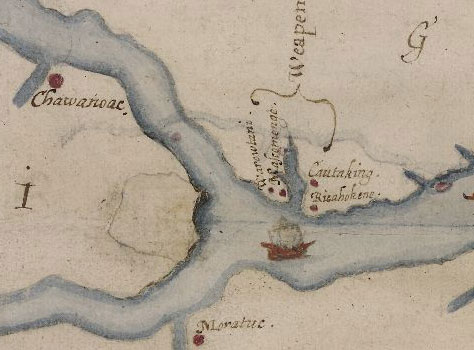
Researchers from the U.S. and U.K. announced earlier today that a 16th century map of coastal Virginia and North Carolina reveals the location of a planned fort or settlement. And, they suggest, that spot, at the confluence of the Roanoke and Chowan rivers, may be where settlers from the Lost Colony headed.
The lozenge shape on John White’s “Virgenia Pars”, which researchers suggest represents a fort, was discovered when experts at the British Museum used lights and other techniques to study details hidden by a patch on the map.

A panel of historians and archaeologists assembled by the First Colony Foundation discussed their findings and theories this morning at Wilson Library in Chapel Hill. Panelist James Horn, an historian and author of A Kingdom Strange: The Brief and Tragic History of the Lost Colony of Roanoke, says that before John White left his fellow colonists in 1587, the settlers had already discussed moving about 50 miles inland. That distance roughly compares to the location of the fort depicted on the map. Additional details of the First Colony Foundation’s research and theories are here.
White’s “Virgenia Pars” map is considered relatively accurate in its depiction of the region’s geography. And The News and Observer reports that the site of the planned fort or settlement is “near Scotch Hall Preserve, a golf course and residential community just across the Albemarle Sound from Edenton.”
Although archaeologists expect to study the area of the planned fort or settlement, a timeline for such work has yet to be disclosed.
if there was a fort and the colony did head there, wouldn’t there had been something recorded in the logs of this? either at the settlement or at the so called fort?
true but perhaps they thought that they were going to croatoan island because the words croatoan and cro wee carved into trees which means they intended to go there.
No you’re wrong
they never kept logs.
Excuse me, but one thing crosses my mind over this finding, well actually more than one, but the main one. If the colonists had moved to what appears to be the other side of the bay. Just 2 rivers over, why weren’t they found? I’m sure that if they had built a fort 50 miles away John White, especially if he knew that that might be possible, would have looked there. Ok, and lets say that he might not have. This mystery is so talked about, and I’m sure even back then it was talked about, someone of that time would have said “Oh yeah! Them? They live over there.”, or even, “Oh yeah! Our grandparents told us about that, and were the lost colonies decendants.” Someone would have known about a new fort created. This makes no sense, and I think that they are just grasping at straws. Give me proof before you say something is solved. And don’t form an expert panel and tell me something that even a woman with just a BA in nursing from the center of the US can see is so full of holes that it wouldn’t hold chickpee’s.
Simon Fernandez led the final voyage with John White to find the colonists in 1591 but sadly John White was not in Charge of this expedition, Simon Fernandez was. it was agreed that they would sail to Roanoke to find the Colonists. when they arrived-the colonists were already gone at least from the looks of it-(for a long time), even the homes were gone, but they found the message (Croatoan) carved on a Palisade fence post, then a small search party went about 3-miles further north on the island of roanoke and found another carving, but it said: (C.R.O.) which was going to stand for (*CROATOAN*) or (*CROSS*) “the sign of the cross”. they traveled in a northerly direction from the fort and village site towards the albamarle sound. Whites map does show a hidden painted place on his old map that shows (A fort) and that is in a northern direction where Scotch Hall Golf Course is today, close to Avoca, NC.
I agree
Maybe the first idea is plausible, perhaps some of the natives helped them and they needed help. That would explain why some of the Natives homes looked like 2 story english houses.
This article seems most likely to me.
https://historycollection.com/lost-colony-roanoke-8-theories-mysterious-island-inhabitants/
As the son of a cartographer in my very early days and a fellow of the Royal Geographic Society in London I have had access to some very old maps dating older than this one. My take on the diamond underneath the patch is that it is nothing more than a North South East and West directional marker.
1) My reasoning is very simple, the 4 points point in the respective directions.
2) the 4 pointed diamond design is inappropriately out of scale as a structure when the rest of the map is in scale. A good detailed map maker I suspect. The diamond is obviously from another hand and another time.
I would follow the principle that a simpler theory is the right one. Attempting to put 21st century thoughts into a situation and settlement in a wild land nearly half a millenium ago is ridiculous. I suspect it will help sell his book but I will follow my gut on this one and say its a directional marker. Ink in those days was fairly organic and would have damaged/eaten the paper down the road hence the paper patch.
-One smart printer
Except that 2 “grand” compasses exist in the upper right portion, and your “directional marker” doesn’t point in any of the correct directions, or to any particular destination. This apple has fallen quite a bit away from the tree…
thats true
It seems strange that John White did not tell anyone about this feature on the map. If it was a hidden secret and he was desperate to find his family. Why did he not disclose the information? If he had done so one might conclude that Capitain John Smith of Jamestown might have had a better chance to find the colonists. Or did John White take this information to his grave? It just seems strange that there is not other historical documentation to corroborate the meaning of this discovery.
Is it weird that the boat in the enhanced second image looks different? It looks like its being blown away from shore by wind. If you squint, it even looks like there is a wake along the bow. Probably just a trick of the lighting.
John, there is only a small chance that the symbol is a compass rose. The points do not, in fact, point due north, south, east, and west. Rather, they point quite nearly to northeast, northwest, southeast, and southwest. Moreover, the symbol is similar to forts that White painted when the crew reprovisioned in the Caribbean on their way to Roanoke. The symbol’s shape resembles the standard pentagram fort of the era, which were designed to minimize the impact of incoming projectiles. Rather than constructing the fort with four straight walls, builders angled them so that incoming cannon balls would not perpendicularly strike any wall. In all liklihood, the symbol on the map is a planned fort or a fort that the colonists constructed while in the area, as Algonquian settlements were normally circular.
if you go to the British museums website for this map further analysis shows that the red “compass rose” covers another diagram that corresponds very much to a fort similar to the types then in use. I theorize that the red area was actually a line denoting the clearing around the fort, but the red ink used at that time bled over the outlines to the fort. As for the wake of the ship going the wrong way, the original pencil outline of the map (before it was colorized) shows the ship sailing in the opposite direction.
Big Jon’s explanation worth noting.
Very interesting indeed. If you’ve read the book “Big Chief ” Elizabeth” there is a fairly convincing reason why John White may have wanted to hide the location of this fort, especially if his colonists retreated to that location from Roanoke. In fact the “Croatan” hint on the tree may have been placed there deliberately by the colonists before they left to hide the true location. They may have had a very good reason for doing this, but you need to read that pretty convincing book to understand more fully. It may seem like just another popular book, but I think the author makes a pretty good case. There is a lot about the lost colony that never made any sense at all to me until I read that book. For example why in the world did White personally leave his colony and daughter and grandchild to go back to England for supplies. He was the governor, he was supposed to stay there. The supply errand did not require his presence. His colony did. The book makes a case that’s hard to refute, and the explanation for White’s reason to leave would also explain why the colonists may have felt compelled to hide.
I also study old Dutch maps of the New World and this symbol looks very similar to some forts I have seen depicted on several maps of this era. It would have made a lot of sense to construct a fortification in this very location from everything I have read about Raleigh’s second voyage. I put my money on that they find something there.
Also the Jamestown colonists searched in this area first when they arrived roughly 25 years later. The reason was because natives had told them they were in this area. This is very intriguing to me.
It sounds very possible but there are no reasons to support it. I agree that if they all had just moved up there then someone would have known about it. Nothing shows us in dialogue or context that they went up there. That just could have been a possible settlement. I do think that is weird that they hid it on the map, though?
It is my understanding that when the “Lion” arrived at the outer banks of Carolina, Fernandez, the Portuguese master of the Lion, was supposed to allow Governor White to pick up 15 or so men who were left on Roanoke Island by Ralph Lane. Lane had had a fort built on the northern end of the island and left the men to hold it after his abortive attempt at colonizing in 1586. White only landed here on Roanoke to pick up those men as per his agreement with Raleigh and the other governors of the new colony then he intended to move further north to Chesapeake Bay. But when Fernandez put White and some of the men ashore he refused to go any further north and insisted on dropping all the colonists on Roanoke because, according to Fernandez, the summer was wearing on and he had to leave for the Caribbean and Spanish shipping he intended to harry.
John Lawson’s map of 1709 shows “Croatan” as the mainland opposite the island of Manteo. Their “failure to find” also had to do with the fear of the Spanish and John White’s captain’s refusal to stay in the area searching. The area had also changed dramatically because of hurricane(s); inlets had closed/opened as they still do today
It’s all very interesting and all should be looked into. Personally I’d go up to the Hollister, NC area or possibly some of the people with native blood in Hertford Co. and try and work my way back via DNA and other processes.
Maybe he covered it up because he decided not to build a fort. or it just was a mistake
I’ll tell you why he covered it up. John White tried to maintain accurate maps, knowing how important accuracy is, thus he changed the map to reflect the settlement having been dismantled and moved. The original settlement was only temporary, as John white himself stated it was agreed to move it “50 miles into the main”. The problem of locating it arises from the fact that modern researchers somehow mistakenly believe the settlement had been on Roanoke Island. The mistake comes from the fact of the Roanoke Indians living on the island at the time, thus researchers believe that is the Roanoke meant by John White. However, the Roanoke John White had meant was the Roanoke River, which is where the patch over the “fort” is located, thus the location of the original, temporary settlement. Now, to move “50 miles into the main” does not mean 50 miles into the mainland as measured from the coast (or Roanoke Island which was at the coast), as modern researchers mistakenly believe. What it means is 50 miles into the main course of the Roanoke River (with no travel along a tributary river/stream). One of the major purposes of a colony is trade, and about 50 miles up the Roanoke River from that settlement covering patch is a place where a major Indian overland trade route crosses the river, the river itself also being an Indian trade route. That would have been an ideal spot to set up a settlement/trade center, so that is the location they moved to from the original, temporary settlement, and John White knew it though he was not able to go there due to a bad storm (possibly a hurricane) coming along. Others tried to locate the settlement in the following years but without success. The reasons are, they were either not privy to the agreed upon location of the permanent settlement/trade center, and/or bad storms (again possibly hurricanes) coming along at the times of the later ships arrivals. Anyway, the descendants of the Roanoke settlers are still among us today. Some of them are descendants of Roanoke settlers and Indians, but the majority of Roanoke descendants today make up few million people. I know who they are and where they are but I will not reveal that just yet, as I am writing a paper on all of this.
I am interested in reading your paper on this
Do any of you see the skeletons on the map? September 16th 2018
If we don’t know why don’t we just go explore where the patch is
let me reveal, straighten out and correct a little bit of a History-Mystery here. the word CROATOAN was meaning the swampy inland area of North Carolina off the western coasts of Roanoke island. the Croatoan Natives main home and villages were there, modern day (Dare, Washington, Bertie and Tyrrell Counties), where the Croatoans live today of the mainland parts, not the Island. Croatoan peoples were inland on the mainlands of North Carolina also, not just any of the Islands like hatteras. the only reason the Native croatoans stayed there was the Fishing industry they had at the time, it was semi-permanent as during the winter they sailed back to the mainland for winter reasons.
the words “Croatoan” and “Cro” are not the same words since the next word was just 3 letters long. the second word was going to be “Cross” –the sign of the Cross. but no one carved the last two “SS’s.” Governor John White said in a message to all the colonists was: “leave a message where you are going and leave the sign of a “cross” so we will know where to go and find you”. from the carved word [Croatoan] at the old fort, to the second word {Cro} which was 3 miles away, goes in a northward direction only. they went north towards modern day Avoca, North Carolina (Bertie Co.).